



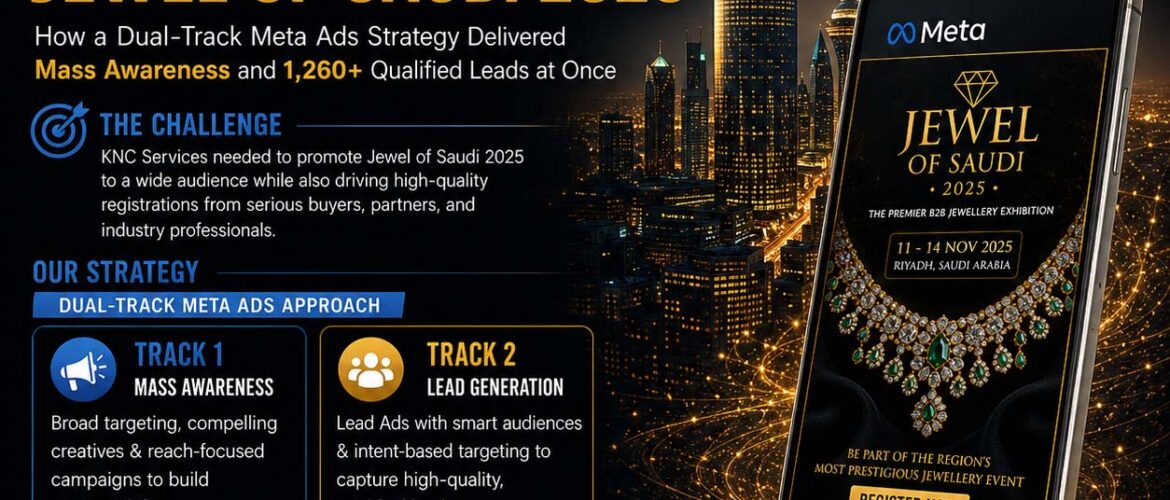
Event marketing has a problem most other campaigns don’t: it has to succeed on two completely different fronts simultaneously, using the same budget, in the same time window, without a second chance to course-correct once the event date arrives. Get the awareness side wrong and no one shows up. Get the lead generation side wrong and the people who do show up are the wrong ones. This was exactly the challenge Social Scoop faced with Jewel of Saudi 2025, a major event run under KNC Services — and it’s what shaped every decision in the Meta Ads strategy we built for it.
This is the story of how a dual-track Meta Ads campaign, split deliberately between awareness and lead generation, delivered efficient mass reach on one side and 1,260 combined qualified leads from visitors and exhibitors on the other — proving that with the right campaign architecture, a single event doesn’t have to choose between scale and quality.
About the Campaign: The Event Behind the Case Study
Jewel of Saudi 2025 is a major event under KNC Services, and like most large-scale exhibitions, its success depended on far more than simply “getting people to know about it.” The event needed to do two very different jobs at once: get as many eyes on the event as efficiently as possible, and generate genuinely qualified leads from the two audiences that mattered most — visitors and exhibitors. Those two audiences don’t just differ in size; they differ in intent, in what convinces them to sign up, and in what they’re actually looking for from the event, which meant the entire campaign had to be built around that distinction from day one rather than treated as a single generic push.
The Challenge: Awareness and Lead Generation Pull in Different Directions
Here’s the tension at the core of nearly every event marketing campaign: awareness and lead generation typically pull in different directions. Awareness campaigns are built to reach the widest possible audience at the lowest cost — which means optimizing for scale, not qualification. Lead campaigns are built to do the opposite: filter that same broad audience down to the people who will actually convert, which almost always means sacrificing some scale in exchange for quality.
Running both well, at the same time, without one undermining the other, is the real challenge behind any serious event marketing strategy — and that’s exactly what KNC Services needed from this Meta-driven approach. A campaign that leaned too hard into awareness would generate impressive reach numbers but fail to fill the event with the right attendees and exhibitors. A campaign that leaned too hard into lead generation would produce a trickle of high-quality leads but leave massive potential audience reach entirely untapped. The solution wasn’t picking one — it was building both, properly separated, so each could be optimized on its own terms.
Our Approach — Performance Marketing, Awareness
Rather than running a single, blended awareness effort, we split it into two distinct campaign types run side by side, each optimized for a different job:
- A pure Awareness campaign, designed specifically for maximum efficient reach — getting the Jewel of Saudi 2025 name in front of as many relevant people as possible, as cost-effectively as possible.
- An Engagement campaign, designed to go deeper with the audience it did reach — trading some of that raw scale for stronger interaction, building a warmer audience that would matter later in the funnel.
Running these two side by side, rather than picking just one, meant the campaign could capture the benefits of both: broad, cost-efficient visibility from the Awareness track, and meaningful interaction depth from the Engagement track.
Our Approach — Performance Marketing, Lead Generation
In parallel with the awareness effort, we ran two distinct lead generation tracks, tailored specifically to the different audiences the event needed to convert:
- A JOS Visitor campaign, built to generate enquiries and sign-ups from prospective attendees.
- A JOS Exhibitor campaign, built specifically to generate leads from businesses interested in exhibiting at the event.
This split mattered because a potential exhibitor and a potential attendee need to be spoken to entirely differently — different messaging, different value propositions, and often different creative altogether. Treating them as a single undifferentiated lead pool would have diluted the effectiveness of both.
The Results: Breaking Down Every Campaign
The Awareness Campaign reached 24,25,652 people with 31,59,385 impressions, generating 1,247 link clicks and 2,203 total clicks, for a spend of ₹5,770.72. This was, by design, the highest-reach, lowest-cost element of the entire strategy — built purely to maximize efficient visibility.
The Engagement Campaign reached 3,96,594 people with 4,25,225 impressions — a far smaller footprint than the Awareness campaign — but it punched well above its weight on interaction, generating 869 link clicks and 2,727 total clicks, for a spend of ₹12,348.13. Despite reaching roughly one-sixth of the audience the Awareness campaign did, it produced more total clicks — a clear signal that depth of engagement, not just breadth of reach, was doing real work here.
Taken together, the two awareness-side campaigns told a clean, complementary story: Awareness campaigns proved 6x more efficient for scale, reaching far more people at a lower cost per person, while Engagement campaigns proved better for driving actual action — despite lower reach, they generated more total clicks from the audience they did reach. The one soft spot flagged in the data was CTR on the Awareness campaign, sitting at 0.07%, identified as an area worth optimizing in future iterations of the strategy.
On the lead generation side, the two campaigns showed an equally instructive contrast:
- The JOS Visitor campaign reached 65,323 people, generated 2,101 clicks, and converted at a CPL of ₹43.62, producing 380 leads for a total spend of ₹16,574.30.
- The JOS Exhibitor campaign reached 3,30,540 people, generated 10,636 clicks, and converted at a CPL of ₹44.87, producing 880 leads for a total spend of ₹39,484.33 — making it the clear scale engine of the two lead generation tracks.
Despite generating fewer total leads, the Visitor campaign was the more cost-efficient of the two, and its click-to-lead efficiency was genuinely outstanding: an 18.1% conversion rate, compared to 8.3% for the Exhibitor campaign. That’s more than double the conversion efficiency, even though the Exhibitor campaign delivered more than twice the total lead volume — a reminder that “more leads” and “more efficient leads” are two different wins, and a well-built campaign structure can deliver both simultaneously rather than forcing a trade-off.
The near-identical CPL across both campaigns — ₹43.62 for Visitors versus ₹44.87 for Exhibitors — is itself a meaningful result. In event marketing, wildly different CPLs between audience segments often signal a targeting or messaging problem in one of the campaigns. Here, that consistency pointed to excellent targeting and strong funnel health across both audiences, even though the campaigns were built and optimized independently.
Why This Case Study Matters for Other Event & Exhibition Marketers
The Jewel of Saudi 2025 campaign offers a genuinely reusable framework for anyone marketing a large-scale event, exhibition, or conference:
- Don’t blend awareness and lead generation into one campaign. They optimize for opposite things — scale versus qualification — and trying to do both in a single campaign structure usually means doing neither particularly well. Splitting them, as this campaign did, lets each be optimized on its own terms.
- Different audiences need different lead campaigns, not just different ad copy. Visitors and exhibitors weren’t just given different messaging within the same campaign — they were run as entirely separate campaigns, which is what allowed each to be measured and optimized independently.
- Engagement campaigns can outperform awareness campaigns on action, even with far less reach. The Engagement campaign’s higher total clicks despite a fraction of the Awareness campaign’s audience is a strong argument for including a dedicated engagement layer in any awareness strategy, not just a single broad-reach push.
- Consistent CPL across different audience segments is a health signal worth watching. When cost per lead stays close across genuinely different audiences, it’s a strong sign the targeting strategy — not luck — is doing the work.
- Higher conversion rate and higher lead volume can both be wins, just different ones. The Visitor campaign’s 18.1% conversion rate and the Exhibitor campaign’s 880 total leads represent two different kinds of success from two different strategic goals — both worth reporting on their own terms rather than forcing a single “winner.”
Final Thoughts
The KNC Services – Jewel of Saudi 2025 case study demonstrates that event marketing doesn’t have to force a trade-off between reach and quality. By deliberately splitting the strategy into an Awareness campaign for efficient mass reach, an Engagement campaign for deeper interaction, and two audience-specific lead generation tracks for Visitors and Exhibitors, Social Scoop delivered a Meta Ads strategy that hit both goals at once — broad, cost-efficient visibility, and genuinely qualified leads across both of the audiences that mattered most to the event’s success.
Planning an event or exhibition that needs both reach and results? Get in touch with Social Scoop, Mumbai’s full-service digital marketing agency for performance marketing and event promotion, and let’s build a campaign strategy tailored to every audience your event needs to reach.
Leave A Comment